
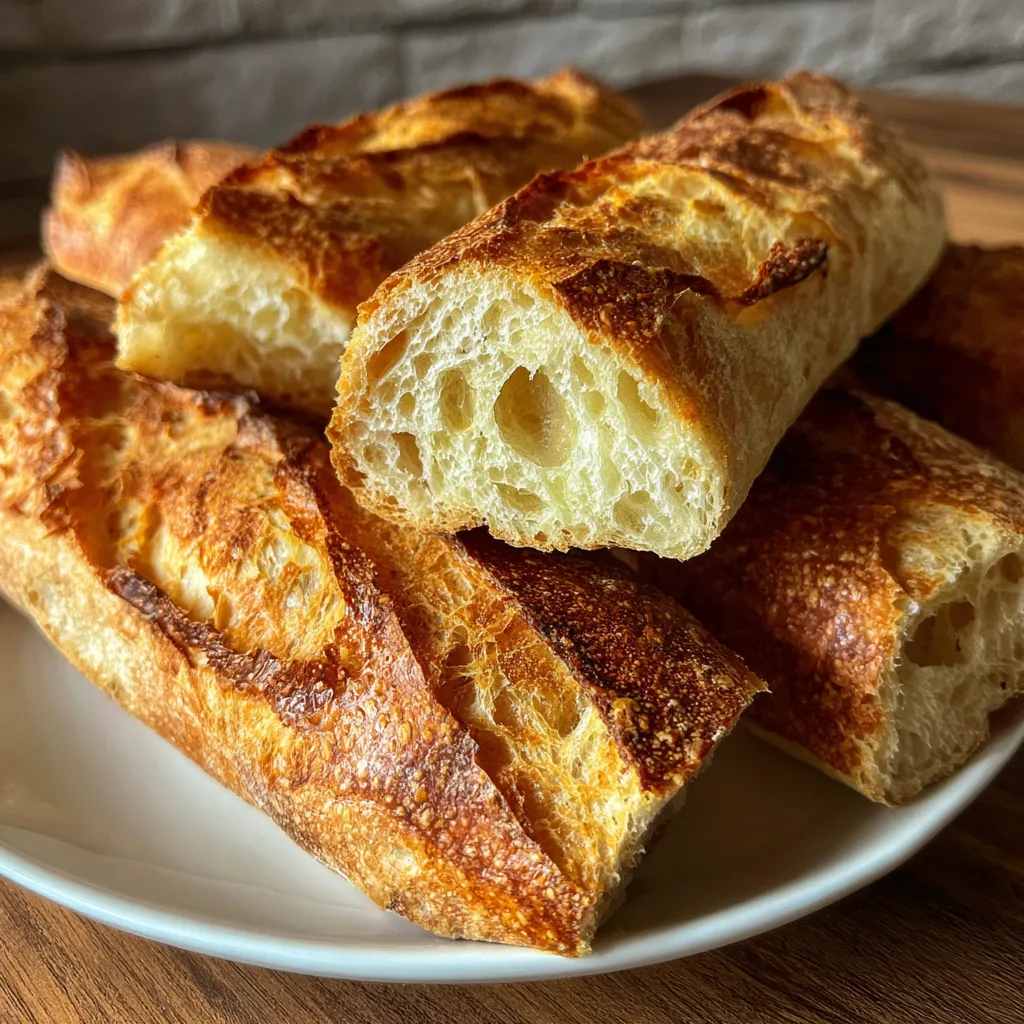
Rustic Golden Crispy French Baguette brings the charm of an artisan bakery right into your kitchen. With just flour, water, yeast, and salt, you’ll create a loaf that crackles with a golden-brown crust and gives way to a light, airy interior. This no-fuss recipe is perfect for breakfast or as an impressive side, and it’s guaranteed to fill your home with irresistible warmth. Grab your mixing bowl and baking sheet—we’re about to bake the baguette of your dreams!
These simple pantry staples combine effortlessly to yield that crackling crust and pillowy interior of a classic French baguette.
Baking the perfect baguette is all about timing and technique. From mixing the dough to creating steam in the oven, each step builds on the last to give you that iconic crispy crust and soft interior. Follow these details closely, and you’ll master this intermediate-level recipe in no time.
1. In a large bowl combine bread flour and sea salt, stirring to distribute evenly across the dry ingredients and ensure consistent seasoning.
2. In a separate container dissolve active dry yeast in lukewarm water and let sit for 5 minutes until foamy, confirming the yeast is active.
3. Pour the yeast mixture into the flour mixture and mix with a sturdy spoon until a shaggy dough forms, making sure no dry flour pockets remain.
4. Turn the dough onto a lightly floured surface and knead for 8–10 minutes until it’s smooth, springy, and elastic.
5. Place the dough in a lightly oiled bowl, cover with plastic wrap or a damp cloth, and let rise for 1 hour or until doubled in size.
6. Gently deflate the dough and divide it into two equal pieces; shape each into a long baguette by rolling and tapering the ends with your hands.
7. Place the shaped loaves on a parchment-lined baking sheet or baguette pan, cover, and proof for 45 minutes, allowing them to puff up.
8. Meanwhile preheat the oven to 220°C with a baking stone or an inverted heavy sheet on the middle rack and a saucepan on the bottom rack.
9. Just before baking, make 3–4 diagonal slashes on each loaf with a sharp blade and pour ½ cup of hot water into the saucepan to generate steam.
10. Bake for 20–25 minutes until the crust is deep golden and crispy, then transfer to a wire rack to cool completely, preserving the crumb’s structure.
These Rustic Golden Crispy French Baguettes shine in countless ways, whether you’re hosting a cozy brunch or craving a rustic snack. Here are four delicious serving ideas to highlight that crackling crust and tender interior.
Mastering this baguette takes practice, but these friendly pointers will ensure your crust is golden and your crumb is airy every time.
Once you’ve enjoyed that first warm slice, here’s how to keep your baguettes fresh and crunchy so no crumb goes to waste.
Here are answers to some common baguette baking queries in a friendly nutshell.
Bread flour has a higher protein content (about 12–14%) compared to all-purpose (10–12%) or whole wheat flour, which helps develop stronger gluten and produce the characteristic chewy crumb and crispy crust of a baguette. You can substitute up to 25% of the bread flour with whole wheat, but keep the rest as bread flour to maintain structure. If you only have all-purpose, you may still get a decent loaf, though the rise and chew might be slightly less pronounced.
After about 8 minutes of kneading on a lightly floured surface, the dough should feel smooth and elastic rather than sticky. You can perform the “windowpane test”: gently stretch a small piece of dough between your fingers—if it stretches into a thin translucent membrane without tearing, it’s sufficiently kneaded. If it tears easily, knead another minute or two until it passes this test.
Preheating a baking stone or inverted sheet on the middle rack ensures even bottom crust browning by providing a hot surface that mimics a professional deck oven. The saucepan on the bottom rack holds hot water added just before baking; this generates steam that delays crust setting, allowing the loaf to expand fully and develop a glossy, crispy exterior.
Yes. After the initial mix and brief knead, perform a cold fermentation by placing the dough in a lightly oiled bowl, covering it, and refrigerating for up to 16 hours. This slows fermentation, deepens flavor, and improves crumb. The next day, remove the dough, let it warm for about 30 minutes, then gently deflate, shape into baguettes, proof for 45 minutes, slash, steam, and bake as directed.
A poolish is a preferment made by mixing equal weights of flour and water with a pinch of yeast (for example, 100 g flour, 100 ml water, 0.5 g yeast) and letting it ferment for 12–16 hours. To use it, reduce the recipe’s flour and water amounts by the poolish’s weight (in this example, subtract 100 g flour and 100 ml water) and add the bubbly poolish when you mix the dough in step 3. This adds complexity to the flavor and aroma of your baguettes.
As the loaves cool, steam inside redistributes and the crumb structure sets. Slicing while hot releases moisture too quickly, leading to a gummy or collapsing interior. Waiting at least 1 hour ensures the crumb firms up, giving you neat slices with an open, airy interior and perfect chew.
Store cooled baguettes in a paper bag or wrapped loosely in a kitchen towel at room temperature for up to 24 hours. Avoid plastic, which traps moisture and softens the crust. To refresh, spritz the loaf lightly with water and bake in a 190 °C oven for 5–7 minutes. The steam will revive the crust’s crispness and warm the crumb without drying it out.
This Rustic Golden Crispy French Baguette stands out because it uses nothing fancy—just basic ingredients and smart techniques like steam and a hot baking surface—to deliver bakery-quality results. The contrast of the crackling golden crust against the soft, pillowy crumb is unbelievably satisfying. Whether you’re an intermediate baker or just diving into artisan breads, this recipe is foolproof enough to build your confidence and flexible enough to impress any crowd. Print and save this guide, then let me know in the comments how your baguettes turned out or if you have any questions along the way!
A no-fuss recipe that transforms basic ingredients into a golden loaf with a crackling crust and pillowy interior, filling your kitchen with the warm aroma of freshly baked bread.

¡Hola, cocineros! I'm Alba Morales, and welcome to my kitchen where Spanish traditions meet California innovation, and every recipe is a love letter to the flavors that have shaped my culinary journey.